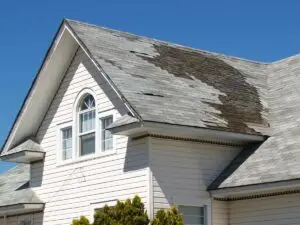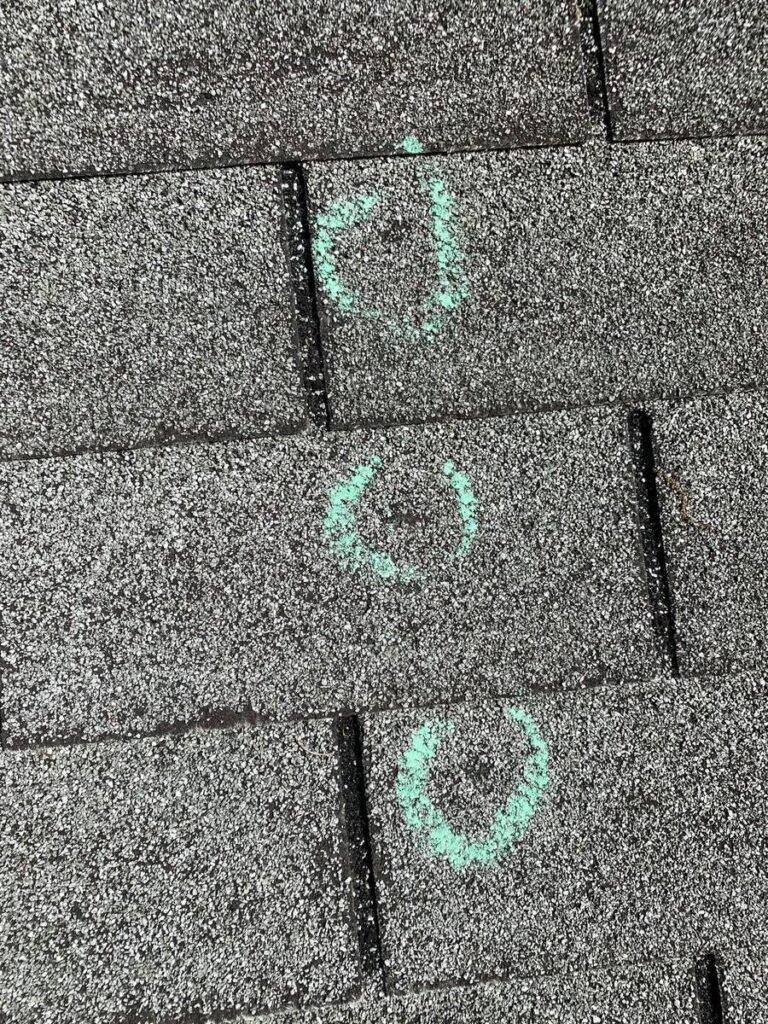
Hail damage to a roof looks like random, dark circular bruises on asphalt shingles — typically 0.5 to 1.5 inches wide — where the protective granules have been knocked off and the underlying mat is exposed. In our 10+ years inspecting roofs across St. Louis County, we confirm roughly 6 to 8 hits per 10’x10′ test square (100 sq ft) is usually enough to warrant a full insurance-funded replacement in Missouri. The damage is often invisible from the ground, which is why most homeowners miss it until it starts leaking 2–5 years later — long after the insurance claim window has closed.
This is the diagnostic guide. If you’re already past identification and need to file a claim, jump to our St. Louis storm damage roof insurance claim walkthrough. Otherwise, keep reading — our roofers will show you exactly what hail damage looks like, how adjusters confirm it with the chalk test, and how to avoid the storm-chaser scams that flood St. Louis neighborhoods after every hailstorm.
What Hail Damage to a Roof Actually Looks Like
Real hail damage has a signature: random distribution, circular impact points, and exposed fiberglass mat where granules used to be. It looks nothing like the straight rows of wear or the uniform aging you see on a 20-year-old roof. Every hit is a little bullseye — dark center, lighter ring — and they appear on every sloped surface the storm could reach.
Here’s the test: stand at the edge of your driveway and look at your roof. You probably won’t see anything. Now look at your gutters, downspout splash blocks, AC condenser fins, grill lid, and mailbox. If hail hit hard enough to dent aluminum or bruise a shingle, those soft metal surfaces will tell the story before you ever climb a ladder. In St. Louis, we see this pattern from Kirkwood to Chesterfield every April and May when the spring severe-weather corridor fires up.
On shingles themselves, you’re looking for four things: bruising, granule loss, cracking, and mat exposure. The next section breaks each one down.
Hail Damage Roof Shingles: The 4 Types of Damage You Need to Know
Not every mark on a roof is hail damage — and insurance adjusters know the difference. Here’s the comparison table we use on every Meridian inspection:
| Damage Type | What It Looks Like | What It Means |
|---|---|---|
| Bruising | Soft, dark circular spots where the mat gives under thumb pressure | Fiberglass mat fractured. Permanent. Always claim-worthy. |
| Granule loss | Black or gray circular spots, granules collected in gutters and downspouts | Exposes asphalt to UV — shingle lifespan drops 50%+ |
| Cracking | Radial fractures or starburst lines emanating from an impact point | Shingle is structurally compromised. Will fail under wind or freeze-thaw. |
| Mat exposure | Light-colored fiberglass visible through a shingle hit | Most severe — water path to the deck. Emergency tarp recommended. |
Two look-alikes get homeowners in trouble: blistering (heat-related bubbles with no impact pattern) and mechanical damage (scuffs from foot traffic or tree limbs). Adjusters reject both. If your whole roof looks like random pockmarks but the distribution is one-sided, it’s probably not hail. Real hail hits every exposure the storm could reach — north, south, east, west — in proportion to the wind direction.
How to Safely Inspect Your Roof After a Hail Storm
We do not recommend climbing your own roof. Period. Over half of the fall injuries we hear about in the St. Louis market come from homeowners trying to verify storm damage the day after a storm. Wet shingles, steep pitches, and adrenaline are a dangerous mix.
Instead, do this:
- Walk the perimeter. Photograph every soft-metal surface: gutters, downspouts, window screens, A/C fins, garage doors, mailbox, grill lid.
- Check the ground. Collect fallen granules from downspout splash zones. A handful of granules after a storm is a red flag.
- Photograph your siding. Hail big enough to hurt a roof will usually chip or crack vinyl and aluminum siding too. That’s corroborating evidence.
- Note the date. St. Louis insurance carriers almost always require a date of loss within 12 months — many within 6.
- Call a certified local contractor for a free inspection. Meridian’s St. Louis roof inspection service is free and includes photo documentation you can submit with your claim.
The Chalk Test: How Insurance Adjusters Confirm Hail Damage
This is the single most important diagnostic tool in the industry, and almost no other blog covers it correctly. Adjusters use it. Contractors use it. And if you learn what to look for, you’ll spot real damage on your own photographs.
Here’s how it works: the inspector rubs a carpenter’s chalk stick sideways across a suspect section of shingle. Chalk catches on elevated ridges — the shingle texture — but skips over bruises where the mat has been softened and flattened by an impact. The result is a high-contrast negative: every hail hit appears as a clean, colored dot against the chalked background.
Then the adjuster draws a 10’x10′ test square (100 square feet) on the most exposed slope — usually the south or west face. They count functional hits inside the square. Most Missouri carriers require 6 to 8 hits per square on the worst slope to trigger a full replacement. Less than that, and you’re looking at a repair or denial.
On our Meridian inspections we do the same test, document with photos, and hand the homeowner a report before the adjuster ever shows up. That way your claim isn’t someone’s word against someone else’s — it’s a chalked, counted, photographed test square your carrier can’t argue with.
How Much Damage Is Enough to Warrant a Full Roof Replacement?
In Missouri, the rule of thumb across most carriers is 6+ functional hits per 10’x10′ test square on any slope. If just one slope hits the threshold, most carriers will approve the entire roof because shingles must match and warranties don’t allow partial replacements on matched planes.
But there are exceptions. If your shingles are 3-tab (common on St. Louis homes built before 2005), the threshold is often lower because 3-tab shingles are more fragile. If you have architectural or designer shingles, adjusters may be stricter. And if you already had a list of signs you need a new roof building up before the storm, the hail is usually the tipping point.
A replacement from hail is generally covered at ACV or RCV depending on your policy. For ballpark pricing, see our St. Louis roof replacement cost guide — most hail-related insurance claims in our market run $12,000 to $22,000 before your deductible.
Filing a Hail Damage Roof Claim: What to Expect
St. Louis is served by a handful of dominant carriers, and each handles hail claims a little differently. Here’s what we see on the ground:
- State Farm — Largest share of St. Louis homes. Uses both in-house adjusters and independents. Tends to approve on a per-slope basis. Photograph everything; their adjusters are thorough.
- Shelter Insurance — Missouri-based, familiar with regional hail patterns. Often fast-tracks claims after major named storms but requires solid documentation.
- American Family — Tends to use third-party adjusters (like Eberl or Pilot Catastrophe) after big events. Having your own contractor present during the inspection is strongly recommended.
- American Modern — Common on older St. Louis homes. Watch deductibles carefully — many policies have separate wind/hail deductibles that can run 1–2% of dwelling coverage.
The full step-by-step claim process, supplemental pricing, and what to do if you’re denied is covered in our St. Louis storm damage roof insurance claim guide — that’s the companion post to this one.
“After the April storm Meridian came out the next day, did a chalk test, and handed us photos before State Farm even called back. The adjuster approved the whole roof. Alex and his team were straight with us the entire time — no pressure, no games.” — M. Hartmann, Kirkwood, MO (verified Google review)
Hail Damage Roof Scams: How to Spot a Storm Chaser
Every major St. Louis hail event triggers a wave of out-of-state “storm chaser” contractors who door-knock neighborhoods for 4–6 weeks, then vanish. We’ve watched it happen after the April 2023, May 2024, and June 2025 storms — and the same warning signs come back every time.
Red flags to watch for:
- Unsolicited door-knocking 24–72 hours after a storm. Legitimate local contractors are booked solid with existing clients and rarely cold-knock.
- Out-of-state license plates and magnetic truck signs. If you can peel the logo off, that’s the whole company.
- “We’ll cover your deductible.” This is insurance fraud in Missouri under RSMo §375.311 and a felony for the contractor.
- High-pressure “sign now” contracts. A reputable contractor gives you time to read and walk away.
- Asking for full payment up front or before materials are delivered.
- No local address you can drive to. Google the address. If it’s a UPS store, it’s a storm chaser.
Meridian Roofing and Renovation is 100% locally owned and operated right here in St. Louis. Our shop is real, our phone number has answered for over a decade, and our license is on file with Missouri. If you’re unsure about any contractor who knocks on your door, ask them for their Missouri state contractor registration and their local business address — and then call us for a second opinion.
Why Local St. Louis Homeowners Should Act Within 72 Hours
Three things happen when you wait too long:
- Evidence disappears. Granules wash away in the next rain. Secondary storms muddy the date of loss. Tree debris gets mistaken for hits.
- The claim window closes. Most Missouri policies require notice “as soon as practicable,” and carriers routinely deny claims filed more than 12 months (sometimes 6) after the storm.
- Your contractor backlog grows. After a major event, St. Louis roofing crews book out 8–16 weeks. Getting on the schedule early is the difference between a tarp in May and a new roof before the June storms.
If you’re replacing anyway, ask your contractor about Class 4 impact-resistant shingles. Brands like GAF Grand Sequoia AS and Malarkey Legacy carry a UL 2218 Class 4 rating, survive larger hail without bruising, and qualify for a homeowners insurance premium discount with most major Missouri carriers. We cover the full menu in our best roofing shingles for St. Louis guide.
Frequently Asked Questions About Hail Damage Roofs
How big does hail have to be to damage an asphalt roof?
Hail 1 inch in diameter (about the size of a quarter) can begin to bruise standard 3-tab asphalt shingles, and 1.25 to 1.5 inch hail reliably damages most architectural shingles. Anything golf-ball-sized or larger almost always causes claim-worthy damage in the St. Louis market.
Can I file a hail damage claim months after the storm?
Usually yes, but it gets harder fast. Most Missouri homeowners policies require notice “as soon as practicable.” In practice, carriers often reject claims filed more than 12 months after the date of loss, and some reject after 6. File as soon as you suspect damage.
Will filing a hail claim raise my insurance premium?
In Missouri, hail is considered an “act of God” and most carriers do not surcharge a single hail claim. However, multiple weather claims over a short period can affect renewal eligibility. Check with your agent before filing if you’ve had prior claims.
Do I need three contractor quotes before filing a hail claim?
No. Your insurance company pays based on the adjuster’s scope of loss, not competing bids. You only need one reputable local contractor to document damage and perform the work at the approved scope. Multiple quotes can slow the process.
Should I use a storm chaser who offers to “handle my deductible”?
No. Waiving or rebating a homeowner’s deductible is insurance fraud in Missouri under RSMo §375.311 and exposes both the contractor and the homeowner. Any contractor who offers this should be immediately rejected.
How long do I have to replace my roof after an approved hail claim?
Most carriers give you 12 months from the date of the approved claim to complete the work, though some extend to 24 months in catastrophe zones. Don’t wait — St. Louis contractor backlogs stretch quickly after major storm events.
Need a second set of eyes on your roof? Meridian Roofing and Renovation offers free hail inspections across the St. Louis metro. We’re a licensed, insured, locally owned contractor with over a decade of storm work in the region. See our storm damage roofing service, roof replacement service, or contact us online. You can also reach Alex directly at (314) 952-4158.